THE DYNAMIC EARTH: A BLOG ABOUT GEOLOGY AND THE EARTH SCIENCES

Monday, May 11, 2009

Cryptozoology and the History of Science!!!

It's long been known that the psuedo-sciences are bad for your blood-pressure, whether it's creationists or homeopaths or AIDS/HIV deniers or Anti-Vaxxers or Embiggening Earthers. They just make me mad! But of all the pseudo-science wacknuttery out there, I actually have a great deal of sympathy for the poor, lonely, grumpy Cryptozoologist.

Of all the branches of the pseudo-scientific tumbleweed that blows around the fringe-intellectual landscape, cryptozoology is the closest thing in spirit to Real Science (TM). The cryptozoologists are a lot like us, in that they have a legitimate love of critters, the environment, and the general rad-ness of the World. Of course, where we find beauty and wonder in the scientific exploration of the world around us, the cryptozoologist eschews biology and ecology for a more populist-style of old school prophet/naturalist, wandering the wilds and shaking their fists at the rest of us. Still, given as much disdain as they often show for basic field biology and science in general, I love 'em anyway! It's hard not to be charmed by their enthusiasm (often evidenced with just a hint of vitriol on the pre-eminent cryptozoology site on the web, Loren Coleman's Cryptomundo site); you can see something of what made us all go into the sciences reflected in their wild-eyed cryptid hunts.


Of course, the REALLY interesting part of cryptozoology is that skewed nature; what makes some folks into cryptozoologists, and makes others into biologists? And what makes cryptozoology so damn interesting to the public at large? Good luck finding something on The Science Channel or Discovery dealing with the intricacies of ecology, or the comparative anatomy of coelomates! But I guarantee that there is a show on RIGHT NOW about Bigfoot or Alien Big Cats or Mkoele Mbembe somewhere on one of those "scienceish" channels. Why!?!


Well, due to my inside track to the world of The History of Science (thanks Megan!), maybe we'll have some scholarly insight into Cryptozoology world. Joshua Blu Buhs has written a book entitled Bigfoot: The Life and Times of a Legend (click on the link for an excerpt and and interview). The synopsis of the book sounds pretty nifty:

Last August, two men in rural Georgia announced that they had killed Bigfoot.
The claim drew instant, feverish attention, leading to more than 1,000 news
stories worldwide—despite the fact that nearly everyone knew it was a hoax.
Though Bigfoot may not exist, there’s no denying Bigfoot mania.

With Bigfoot, Joshua Blu Buhs traces the wild and wooly story of America’s favorite homegrown monster. He begins with nineteenth-century accounts of wildmen roaming the forests of America, treks to the Himalayas to reckon with the Abominable Snowman, then takes us to northern California in 1958, when reports of a hairy hominid loping through remote woodlands marked Bigfoot’s emergence as a modern marvel. Buhs delves deeply into the trove of lore and misinformation that has sprung up around Bigfoot in the ensuing half century. We meet charlatans,
pseudo-scientists, and dedicated hunters of the beast—and with Buhs as our
guide, the focus is always less on evaluating their claims than on understanding
why Bigfoot has inspired all this drama and devotion in the first place. What
does our fascination with this monster say about our modern relationship to
wilderness, individuality, class, consumerism, and the media?

Writing with a scientist’s skepticism but an enthusiast’s deep engagement, Buhs invests the story of Bigfoot with the detail and power of a novel, offering the definitive take on this elusive beast.

I don't know if the cryptozoologists out there are going to like it, but I think it sounds pretty neat! Might make some good readin' for the field, while we're out there contemplating geology and the wonder of the real world!

Saturday, May 9, 2009

Tafoni!

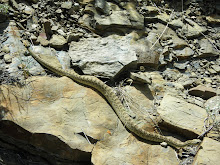
A quick post as the semester wraps up (finally!), illustrating tafoni! Huzzah! The two pictures below are from the Wilkins Peak Member of the Green River Formation, in SW Wyoming.


Tafoni are scoopish-pits in granular rocks (like sandstones...) that are (probably) caused by weathering of differentially cemented zones in the rock.


And by the way, "tafoni" is apparently the plural...the singular is "tafone". Now you know!

EDIT: Yet more Tafoni on the internets! Check out Michael's post on his blog, Through The Sandglass!

EDIT EDIT: Jumpin' Cats! Michael is the Tafoni King at his blog...AND I HAD NO IDEA! Here and Here! Read!

Wednesday, May 6, 2009

What's the harm?

Well, Spring has certainly sprung! Leaves are greenin' up, sun (and rain) is back in the forecast, and the steady creep of "Field Season Anticipation Madness" (FSAM) is slowly overwhelming my ability to sit and work in the dept.

Anyway, if all this springy weather is making you feel TOO HAPPY, you can always go over to What's The Harm? and read some horrible stories of people dying due to stupid psuedo-science and ridiculous superstition. Nothin' like some awful stories of human ignorance and death to take the edge off that sunny afternoon, right!?!

Monday, May 4, 2009

Fixin' Edumacation...

As bad as some folks think grad school is, there are WORSE ways to go about it...


Seized (violently) from here.

Maybe this whole "education" thing isn't as bad as it could be!

Saturday, May 2, 2009

"Graduate education is the Detroit of higher learning"

Mark Taylor, the Chair of the Religion Dept at Columbia, has a pretty interesting Op-Ed piece in the New Yorker, entitled "End the University as We Know It". It's a pretty radical piece of writing that advocates a complete restructuring of the University System, and especially grad school. In fact, the piece starts off with:

Graduate education is the Detroit of higher learning. Most graduate programs in
American universities produce a product for which there is no market (candidates
for teaching positions that do not exist) and develop skills for which there is
diminishing demand (research in subfields within subfields and publication in
journals read by no one other than a few like-minded colleagues), all at a
rapidly rising cost (sometimes well over $100,000 in student loans).

A pretty grim pronouncement...with an uncomfortable degree of truth, probably.

Anyway, Taylor suggests that higher education is in dire need of complete restructuring. To this end, he suggests that we take the following steps:

1. Completely restructure the curriculum: Taylor wants to get rid of the tiered learning structure, and replace it with a "web-like" system of learning and scholarship, with an emphasis on cross-disciplinary education, which leads to his second point...

2. Abolish permanent departments: Taylor does not like the traditional disciplines. Rather, he suggests organizing university programs around questions or research problems, drawing on a range of expertise to interrogate a variety of topics.

3. Increase inter-institutional collaborations: and Taylor doesn't want to just stop there...he wants different universities and institutes to augment their research with workers from elsewhere.

4. Kill the standard model of The Dissertation: probably the easiest sell, right? 600+ page tomes that no one will ever read, AND you have to re-format everything anyway to gets papers out of it? Yes please.

5. Expand the range of professional options for grad students: meaning that they don't JUST TA or RA for their Profs, but do other things (Taylor is a little vague, here)

6. Impose mandatory retirement, and abolish tenure, requiring professors to keep their work new and exciting.

While I agree with the frustration that Taylor feels for higher education (ESPECIALLY in regards to the Dissertation and getting rid of tenure for profs) , I'm not sure if this is the right way to go about reformatting the University. In particular, the perpetual call for "more interdisciplinary work" is always a little bothersome; what exactly is meant by "more interdisciplinary", and how are you supposed to implement it without a sound grounding in the basics of some standard discipline?

What do you guys think?

Thursday, April 30, 2009

Walpurgisnacht Madness!

Did you know it's Walpurgisnacht today!?! Like Halloween, today (and tonight) is supposed to be a particularly dangerous time, in regards to ghosts and witches and general weirdness bleeding through into our "reality-based" world. I'm a sucker for tradition, so in honor of this spooky time, I though I'd share something insane with everyone:

Read THIS and then THIS.

Actually, I might ought to warn you, the first link up there has some...uncomfortable moments. Everyone always brings up the cliche of the car wreck ("can't help but look"), but those links up there? The story linked above isn't so much of a car wreck as it is...a schoolbus-full-of-Hospital-visitation-clowns-that drove-off-of-a-cliff-and-into-the-Large-Hadron-Collider sort of wreck. That sort of thing. You can't help but look!

Anyway, to sum up the insanity here, Neal Horsely is the Georgia Gubernatorial candidate and head of "The Creator Rights Party", which is everything it sounds like. Standard issue wackjob crazy Creationist, with the whole "literal bible, hyper-conservative, anti-fun" sort of stance. Nothing new there. He wants Georgia to secede from the Union so it can live in a more biblically-inspired (i.e., insane) way, ostensibly with him at the helm. He's violently anti-abortion (he's the one who set up the "Nuremburg Files", which listed abortion doctors' phone numbers and addresses), and has contacts with that whole insane group of doctor-murdering "Christians" that we used to hear so much about.

And he has admitted to having sex with a Mule, so there's that.

Frankly, for these sort of ultra-conservative radicals, it sounds like everyday is Walpurgisnacht!

Tuesday, April 28, 2009

Cambrian Hermit Arthropods

The evolution of land animals is one of those iconic geological/paleontological images, even percolating into the popular culture as a symbol of progress. What is interesting, of course, is that popular representations of this seminal event are usually of the fish-to-lungfish-to-vague amphibian sort; what people seem to forget is that the first animals to CONQUER LAND (insert echo here) were invertebrates, bravely going were no metazoan had gone before!

In the past, the first known tracks were thought to belong to an Arthropleura like myriapod (pretty much, a centipede). These tracks are from the Joggins, in Nova Scotia, and are early Silurian in age. Horribly, these tracks seem to suggest that the myriapod that made them was enormous; the picture below, lifted from here, shows a model of one:


Now, however, the earliest terrestrial land animal tracks might belong to a Cambrian arthropod that used a discarded shell, a la Hermit Crabs, to prevent drying out on subaerial tidal sand flat. A recent paper in the April issue of Geology (here's the abstract) by Hagadorn and Seilacher (2009) shows trackways with a peculiar, segmented, shingled-to-the-left tailmarkings. The picture below is their Figure 1 (pg. 295):


The interpreted ethology (that is, behavior) of the critter is labelled in this picture below, Hagadorn and Seilacher (2009) Figure 2 (pg. 296):


These traces show a marked similarity to the traces of modern Hermit Crabs, whose borrowed shells also bump along behind them as they wander the beach. The picture below is of a modern Hermit Crab trace from the Bahamas, and was seized from the Data Repository Items for the paper:


Anyway, the interesting part of this paper is WHY the critter might have carried a shell around behind it. These tracks are found in the Cambrian Elk Mound Group of Wisconsin, and are commonly associated with microbial mats, elephant-skin textures, microbal sand-balls, and other sedimentary structures that suggest extremely shallow to subaerially exposed conditions. One of the reasons that Hermit Crabs lug their shell around is that it serves as a reverse-SCUBA suit; in other words, the Crabs can bring a damp, humid shell along with them to keep their gills in proper working order.

Hagadorn and Seilacher (2009) suggest a similar strategy for this Cambrian tracemaker. The tracks themselves show that the shell was far to small to house the entire critter. Rather, they interpret this as an early behavior that allowed these Cambrian arthropods to exploit the subaerially exposed sand-rich, microbial tidal flats along the Paleo-Wisconsin shorelines. If that's the case, then this is one of the very earliest strategies employed by terrestrial (or at least, amphibious) animals, and it's a pretty derived behavior to boot!

WORKS CITED:

Hagadorn, J.W., Seilacher, A., 2009, Hermit arthropods 500 million years ago?: Geology, v. 37, p. 295-298

Sunday, April 26, 2009

For Sale: Columnar Basalt, Slightly Used, May Be Divine

Wanna see something silly? This. That is silly. Silly enough to end up on CNN, even.


Yup, some wacked-out chowderhead from Idaho has put up some columnar basalt outcrop in his backyard for sale on E-Bay. He claims to see the Hand o'God in the outcrop, which bestowed some sort of magical economic relief to his depressing life, or something. And as of this writing, he's got an offer of around $670 for it, too.

Well, not for It, actually. Just the "rights to it", whatever the hell that means. Still, how often do you get the chance to own some MAGIC basalt? Bid now, geobloggers!

Sed Sunday - Shell beds and shell lags!

Shell-rich beds are great stratigraphic markers and, despite commonly being fairly thin intervals, can provide a lot of information regarding paleoenvironment and paleohydrology. They represent a pretty subtle linkage between biology, sedimentology, and stratigraphy that serves to elucidate complexly interacting attributes of the rock record, especially in regards to sediment accumulation, substrate consistency, and water quality (to name a few!).
Anyway, I thought I'd show a few pictures of shelly intervals for this Sed Structure Sunday. The picture below is from Egypt, and is a good example of a compound bed. Several distinct horizons of different types and abundances of shelly fossils indicate that, despite the thin-bedded nature of this interval, a lot of time is wrapped up in this horizon.


These next two pictures show horizons dominated by a single type of bivalve, Carolia (not sure if that's spelled right...but it's at least a phonetic spelling of the right genus...), showing it's characteristic thin shell. These are from Egypt as well. These are pretty much in-place, as indicated by their delicately articulated shells, and tell us something about the low-energy, clear water conditions of these deposits.


This is in contrast to the picture below, which is also from Wadi al-Hitan, Egypt. It's a big, thick-shelled Pycnodonte, pretty isolated, in a single interval. Upsection, these guys become more abundant, and are eventually overtaken by (and overgrown with) smaller Gryphaea and Carolia beds.


And this last picture is from the core I was measuring last week; it shows a different kind of shelly interval than the previous pictures. Whereas those pics above show in-situ shell beds, this picture shows an erosional scour and shelly lag. These busted up bivalves were transported as bioclasts, and deposited like any other grain in a siliciclastic system.

Saturday, April 25, 2009

Jared Diamond in Trouble

Jared Diamond, of "Guns, Germs, and Steel" fame, is being sued by two citizens of Papua, New Guinea, for allegedly fabricating a story of violence and revenge for a New Yorker article in 2008. The article (which has been taken down, though the abstract can be read here) tells about a feud involving a stolen pig that supposedly resulted in a horrible series of revenge-killings, culminating in a body count of about 17, with numerous injured parties as well. Diamond apparently uses the story to illustrate something about revenge and violence in culture, contrasting the Papau, New Guinea incident with the story of his father-in-law's rejection of revenge in favor of using more civilized methods of discourse (i.e., the Police).

The problem is (well, aside from the disturbing subtle racism in the article) is that Diamond apparently made the whole thing up. Numerous quotes, attributed to the Papaun tribesmen in the story, are apparently amalgamated reminiscences of Diamonds, rather than actual quotes; these faux-quotes were strung together into a longer narrative, undoubtedly to give the story a little more heft (in my opinion, a very common tactic in Diamond's works). Also, apparently the story of the feud is made up whole cloth, while some of the violence described coming from events that happened years before Diamond's story.

You can read a painstakingly detailed examination of the claims here, including a discussion of the lawsuit and the dangers the men who filed it say they are facing due to Diamond's falsehoods.

All in all, it's pretty grim stuff, both legally and scholarly. I've always found Diamond's work a little troubling, anyway; his "Guns, Germs, and Steel" was an exercise in poor scholarship, both in the interpretation of other peoples work as well as failing to cite the people who actually came up with the ideas in the first place.

Look, the guy ISN'T an anthropologist; he's an anatomist. He has NO training in the social sciences, in history, or in human or cultural geography, which is exactly what he's been writing about for years. By the by, ol' Diamond REFUSES to give talks in History or Geography departments anymore. Kind of telling, don't you think? Maybe this will make people stop and evaluate some of his other works as well.