THE DYNAMIC EARTH: A BLOG ABOUT GEOLOGY AND THE EARTH SCIENCES
Showing posts with label critters. Show all posts

Friday, January 13, 2012

Crab Pavement!

Day three of our "dead beach stuff" marathon here at the ol' Blog; you can catch up on all the grim action on these previous posts.  Anyway, today's litore mortem comes again from the Jersey coastline at Sandy Hook.  It was a blustery day, with 40 mph gusts along the shoreline, and very very very cold.  Anyway, the wind was SO strong, it was pretty actively entraining some sand, leaving behind only the largest clasts, including...a whole bunch of dead crabs!


These crabs were littered everywhere, and the aeolian evacuation of sand was leaving behind the crustaceans to form a nifty little crab-enriched interval.


Gruesome, ain't it!?!


Sometimes, the crabs were serving as baffles to the blowing sand, like this little guy below:


Nifty!

Thursday, January 12, 2012

More Dead Things on the Beach!

Continuing the trend from yesterday, here's another picture of some dead stuff I found on the beach over the holiday break!  We've moved out of the Gulf and onto the Atlantic coast, and a far bit more northward as well; these pictures are from Sandy Hook, off the coastline of New Jersey.  It's a ray, washed WAAAAAAAY the hell up on the backshore during a pretty tremendous storm that hit the Atlantic coast.


And here's the poor critter, flipped over.


Wednesday, January 11, 2012

Jellyfish on the Beach

The shoreline is always a fun place to visit; not only is it a picturesque confluence of all sorts of sedimentary and geomorphic processes mingling and interacting with on another, but there's all sorts of wiggy critters and nifty biology to see as well.  Over the break, I had the chance to spend a lovely day at the beach on St. George's island, a barrier island in the Gulf of Mexico not too far from the Oyster Capital of the Gulf, Apalachicola Florida.  Some recent storms had stirred up the shoreface a bit, resulting in some pretty nifty shell hashes and fragments scattered all over.  However, along with the biomineralized detritus cast up by storm waves, there were also a  fair number of these guys:


Jellys!  Subaerially exposed!  Some of these, like the one in the picture above, were exposed in the littoral zone, but a few of comparable size had been chucked up pretty far onto the beach, out of range of fairweather wave activity.  Always fun to see cnidarians, especially when the chance of getting stung in minimal.  Anyway, seeing all these jellys, deposited on well-sorted, upper fine- to medium- grained sand got me thinking about a taphonomy...after all, Jellys aren't called Jellys out of some wry sense of irony.  These soft, squishy, blobby little guys, chucked up into high-energy settings like the foreshore, don't have much of a chance at preservation, especially with a bunch of other critters rambling about over the beach.  However, such was not always the case!

A similar occurrence of cnidarians and high-energy deposits has been documented from the Cambrian, with some very nice examples coming out of the midcontinent region in particular.  Hagadorn et al. (2002) documented a pretty awesome occurrence from the "middle" Cambrian Mt. Simon/Wonewoc sandstones.  Below is their Figure 3, from page 149. 


Pretty cool!  It's a little more densely packed with the tragically stranded cnidarians, and the sedimentary structures are different, but all in all, it's pretty much a Cambrian example of my day at the beach!

Hagadorn et al. (2002) noted that, as discussed above, the taphonomy of jelly preservation requires some sort of explanation.  First off, these deposits don't show any evidence for rapid burial, one of the more commonly evoked explanations for exceptional fossil preservation.  Rather, these jellyfish show themselves, on the basis of both sedimentary structures and the overall stratigraphic succession, to have been deposited in a fairly active shoreface/foreshore paleoenvironment.  Additionally, there's no evidence in these rocks for microbial structures or features, meaning that we can't evoke a "gooey substrate" explanation, either.  So, how did these guys get into the rock record!?

An important hint, recognized by Hagadorn et al. (2002), can be found in the explanation  of why washed up jelly's DON'T get preserved today...namely, lots of scavenging terrestrial critters and especially lots of deep digging bioturbators.  One of the ways the weird world of the Cambrian differs from ours today is the fact that the organisms that do those things hadn't evolved yet, meaning that, for a brief window of time, these sort of "stranding" deposits of organisms are actually pretty darn likely to enter the stratigraphic record.

Just goes to show you that, in addition to our uniformitarian world view, we also have to keep in mind the arrow of secular variation, and how dynamic and complex the interaction is between critters and their environments.


WORKS CITED

Hagadorn, J.W., Dott, R.H., Jr., and Damrow, D., 2002, Stranded on a Late Cambrian shoreline: Medusae from central Wisconsin: Geology, v. 30, p. 147-150

Tuesday, January 10, 2012

Desert Horned Lizard!

A quick picture of some more neat-o herpetofauna!  This one is a desert horned lizard, from the Valley of Fire State Park in Nevada.


Pretty slick camo, eh?

Thursday, December 1, 2011

Burgess Fauna Zapruder Film

Here's something to start the day off RIGHT!  A little movie, from the Royal Ontario Museum, showing a catastrophic mud-rich turbidity current sweeping over some poor Burgess Critters!  They've even got the ol' cinematic rumble going on!  Poor little Anomalocaris!

Saturday, October 15, 2011

Whale-Fall Puppet Theater

Radiolab, a completely slick science-and-culture type of show on NPR, recently discussed a Whale Fall in one of their episodes.  Whale carcasses represent pretty rich food sources in the oceans, and whole communities of organisms spring up when some poor cetacean kicks the bucket and drifts down to the seafloor.  Anyway, a former intern of the show apparently was able to wrangle some very talented folks into making a completely awesome video illustrating the whale fall!  The best part - it's all done using paper cut-outs!  Cute little paper polychaetes, munching on a dead whale!  What more can you ask for!  Anyway, here's the video, yanked from the radiolab site:


Whale Fall (after life of a whale) from Sharon Shattuck on Vimeo.

Friday, September 9, 2011

Inoceramid Bivalves in the WIKS

The Western Interior Cretaceous Seaway (or "WIKS" as all the cool kids call it, which is a way better acronym than the stupid sounding KWIS that I sometimes see...) was pretty darn weird, when you get right down to it.  First of all, we've got us a huge seaway that, by the Late Cretaceous, connected the boreal arctic waters of the north to equatorial waters in the Cretaceous equivalent of the Gulf o' Mexico.  The seaway followed the general trend of a big ol' foreland basin, a zone of subsidence adjacent to the Sevier fold-and-thrust belt.  At it's greatest extent, the seaway's western shoreline ran south from Alaska, through western Alberta, Montana, Wyoming, Utah, and and down into Mexico, while it's eastern shorelines were ~ 1000 km away.  North America was a pretty different place in the Cretaceous!

Because this seaway was on continental crust, it wasn't very deep.  I've seen depth estimates as high as 700 m or so, but to be honest, I find that a little hard to swallow.  On the basis of the geodynamics of thrust emplacement and the subduction response of the foreland basin, as well as some work that's been done on benthic foram assemblages, I think the evidence seems to point towards a shallower, 200-300 m depth range or so. 

Regardless, you can imagine that the environment of the WIKS must have been pretty unusual.  A long, shallow trough of seawater, connecting to very different portions of the open ocean.  And remember, pCO2 estimates and minimal (i.e., no) evidence for high latitude glaciations suggests elevated temperatures in the Cretaceous.  Shallow waters and high evaporation rates means that you've got an opportunity to develop some really salty, briny, and generally unpleasant water in the Western Interior.  Interestingly, elevated global temperatures might result in considerably less thermal gradients between equatorial and polar water masses, meaning that Cretaceous oceans might have been considerably less thermally stratified.  As an aside, it's largely thermally-driven density differences in water masses today that drive the large-scale conveyor belts of ocean currents, which is why anthropogenic climate change has a real potential for screwing up ocean circulation.  In the Cretaceous, salinity-driven differences in ocean water density might have had a more profound role in driven oceanic circulation.  For this reason, big huge inland seaways, like WIKS, might have been important sources of hot, briny water for driving halothermal circulation.

Of course, we have evidence for unpleasant WIKS environments from more than just paleoceanographic thought experiments.  One of the most striking characteristics of WIKS sediments is the fact that the muddy portions of the basin are chock full o' carbon.  These black shales can have some shockingly high TOC (Total Organic Carbon), and must have formed under conditions of VERY restricted oxygen availability, anything from complete anoxia all the way up to more gentle dysoxic conditions.  In fact, some of these black shale intervals are so striking, and so laterally persistent, that they've been given names: Ocean Anoxic Events, or OAEs in the acronym-rich jargon of geology. 

So, in general, we know that a lot of the Western Interior seaway was kind of a rough place to make a living.  The impact of this salty, oxygen-starved seaway on biological communities within the seaway is seen in the sort of things that lived and died there.  For one thing, ammonoids, those opalescent shelled cephalopods that everyone loves, where all over the western interior seaway.  Interestingly, modern examples of shelled cephalopods in the form of Nautilus have exceptionally high tolerance for low-oxygen conditions.  Apparently, modern nautiloids will flee predators by going into low-oxygen waters, closing up there shell to conserve oxygen.  Predatory fish, who burn oxygen like crazy as part of their active hunting life-style, can't follow a potential Nautilus into those zones.  It's a pretty neat trick, and maybe part of the reason why ammonoids were so successful in the WIKS.

But nifty cephalopods weren't the only things living in the seaway.  A completely rad group of bivalves, called inoceramids, are present in a lot of the fine-grained, distal portions of the western seaway, where they serve as important biostratigraphic markers.  These guys are clams, and the group is characterized by having valves that are both big and flat, with some examples getting to be well over a meter.  The picture below is from the Cenomanian of Kansas; the hashy, craggly, flaggy parts (one is juts under the hammer) are inoceramids.


If you look a little closer, you can see the characteristic prismatic texture of the shell; this isn't a diagenetic effect, but rather how the inoceramus precipitated it's carbonate shell.  The picture below shows this texture, particularly on the right hand side.  Any sed geochem types out there know of any isotopic work done on these shells?  Seems like it might be an interesting recorder of bottom water conditions.


Another characteristic thing about these clams is that, in plan view, the shells exhibit marked growth rings.  This kind of crappy picture is from the type section of the Cenomanian-Turonian boundary in Colorado; you can see a bit of the ringed morphology of an inoceramid; this poor little guy got himself chewed up as part of a sandy turbidity current.  Would that we all could go so nobly into that good night!


The large size of these clams has been explained as being a response to the low oxygen conditions of the WIKS; big clams have bigger gill surface area, and could maybe pull in more oxygen in those rough conditions.  They're also some suggestions that these guys might have had chemosynthetic bacteria living symbiotically with them.  What is kind of weird is that, for how big the shells are, there wasn't a lot of room for the squishy bits in the middle...in other words, these clams, though impressively massive, would have been disappointing eating, I suspect.

I also wonder how the chemistry of the WIKS water might influenced these guys.  We know that there are phases of the Western Interior that are dominated by thick successions of chalk.  Maybe these clams dealt with all these ions in solution by precipitating a bunch of CaCO3? 

Anyway, they're pretty nifty fellows, and very characteristic of the fine-grained portions of the WIKS.  Just goes to show you that, even in the most monotonous-seeming mudrocks, you can still find cool stories about the evolving earth!

Wednesday, September 7, 2011

I've got some Macrobugs too!

A few days back, Callan posted some really awesome pictures of some of his local arthopods.  I thought I'd share some crawlies as well, although mine aren't local.  These are pictures from a muggy mountain hike on Taboga, an island on the pacific side of Panama. 

I didn't put any scale bar on this one, but this damn caterpillar was around seven inches long, and started waggling it's head around when we got close to get a picture.


This was a pissed off tarantula, who was busy hunting, and didn't want his picture taken.  About as big as my hand (my hands are 38 inches across).

Thursday, August 18, 2011

Nifty phytoplankton bloom image

An awesome image of a huge plankton bloom in the Barents Sea, courtesy of the MODIS from the Aqua Satellite, taken on Aug 14.  The Barents is at its freshest and most nutrient depleted during this time, due to glacial melt, which creates ideal conditions for a big ol' bloom of these tiny little organisms.  Apparently, the milky blue colors are inferred to be the result of a bunch of coccolithophores, tiny photosynthetic bugs that make a produce calcite tests.  Just think; if you were in orbit during the Cretaceous over the eastern end of the Western Interior Seaway (say, Kansas or Nebraska), you might have seen just such an scene!  And check out those Helmholtz whirls where the plume is mixing with the ambient water!  Rad!


 The image, and more information about it, can be found at NASA's Earth Observatory page.

Wednesday, August 10, 2011

Cooper's Hawk

A prospective buyer expresses interest in a used Ford Explorer:


Wednesday, June 30, 2010

Book Cliffs Lizard

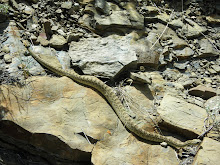
Just a quick post, with some nifty pictures of a big ol' lizard I ran across out in Utah recently. It's around 8 inches long or so (with the tail, mind you), and looks like some kind of skink-like little herp. Anybody got any better ID?

Anyway, enjoy:


Sunday, May 23, 2010

Nifty Owl Video

Nothin' geo-flavored in this post: just a completely kick-ass owl video that I recently stumbled across. The video is from some Japanese TV show, but here's a brief run-down, at least as far as I can tell from the images and different critters being shown.

The owl being shown is (probably) a Common Scops Owl (Otus scops) from South Africa. First thing you'll notice, is that it is cute as hell. However, if you stick with the video a little while, they get to the point of showing that this little guy has some awesome defense/predator avoidance strategies. Here's the video:


When the little Scops owl is confronted with a barn owl (which is just a LITTLE bigger than he is), it really puffs out in an attempt to make itself look huge. But when it's confronted with the much larger and more intimidating Eagle Owl (complete with the Imperial March as it's theme song), it instead elongates itself, producing a much slimmer, narrower profile. According to this info I found at ARKive, it seems like this is a strategy meant to make the Common Scops look more like a twig or branch!

Neat!

Tuesday, February 23, 2010

The Saddest Trace Fossil In The World

Trace fossils are great sedimentological tools; they can tell us a lot about the local energy conditions, instantaneous sedimentation styles, and substrate conditions, and tend to be controlled by traditionally hard-to-figure-out paleoenvironmental proxies like salinity, light, and nutrient availability. So, seds-oriented folks trying to get some really detailed info about depositional environments tend to go crazy over these arcane little scratches, tubes, and trails found in the rock record.

However, if you're one of the paleontologically oriented sorts, then I reckon trace fossils must be really aggravating, form a biological perspective at least. Oh, sure, you can get some morphological detail out of them, and narrow down the sort of critter that made them, but don't you just hate how damn COY those little fossils are about the trace-maker's REAL identity?

In a few lucky cases, though, the sedimentary record has conspired to give us little glimpses of the tracemakers identity. But man! It's just so sad, isn't it:


The picture above is of the Jurassic Horseshoe crab Mesolimulus walchi, from Germany, along with its very own preserved trail (probably of the ichnogenus Kouphichnium, but I might be wrong). I took these pictures at the AMNH a couple of years ago...and it was under weird museum mood-lighting, so it was a little darker than optimal for picture taking.


Anyway, this poor little fellow was just tooling along the anoxic bottom, trying to find some oxygen, I reckon, when he just gave up the ghost. I mean, look at him there, and the end of his trail, forever entombed in sediment!


The pathos!

Sunday, September 27, 2009

Hawk vs Duck

Just a quick picture, taken from the loading bay in our department, of a hawk, enjoying a leisurely meal...

...actually, it's a little ominous, I reckon.

Thursday, July 30, 2009

Field Pictures

Gotta get a post in before July vanishes! I've been out fieldin' it up in Wyoming since mid-June or so, which has resulted in a SHOCKING lack of updates; luckily for me, the geoblogosphere gets pretty quiet come the summertime, which I choose to interpret as evidence for Milankovitch cyclicity as an allogenic forcer on the internet. THERE IS NO OTHER VIABLE INTERPRETATION.

Anyway, thought I'd just post up a quick few pictures of the pretty scenery out West; maybe at the end of the field season I'll put some sed/strat specific pictures up, but these ones below are more of your "Gosh-golly-geewilikers! Purty!" type of pictures.

This first picture (below) shows the Green River Formation (Eocene); the yellowish-tan stuff at the base of the cliff is the Tipton, while the white-colored interval (shot through with some pretty rad brown sandstone) are the Wilkins Peak Member (that's my baby). The river in the background is the Green, making the Flaming Gorge Recreation Area behind a dam.


This next picture is Exhibit #34591 in the continuing series "Rocks That Have Been Shaped Into Rude And Amusing Shapes"; its a pinnacle made up of the volcaniclastic-rich deltas of the Sand Butte Bed, which marks the fillin' in of Eocene Lake Gosiute. On the topo maps of the area, this feature is referred to as "South Chimney Butte"; the Locals have another name for it.


This picture is of the Green River Formation, expressed on the EASTERN side of the Rock Springs Arch, sort of near(ish) to the town of Wamsutter. The red-n-green funtime strata are alluvial and fluvial strata of the Cathedral Bluffs Member (equivalent to the Wilkins Peak on the West flank of the Arch), while the lakey lookin' white tannish/whitish stuff in the Laney Member of the Green River Fm.


Finally, here's a picture of a Hawk that was yelling at me for a good couple of hours. I must have been taking paleocurrents in it's living room, since there was a huge nest not to far away from where this picture was taken.


All right, back to the Field!

Monday, June 1, 2009

A life-sized Whale, in the comfort of your own Home

Check this out! It's a life-sized whale, put up on your computer screen; you can click and drag all over the critter, and get a sense (sort of) of just how big it is. Those with access to really nifty huge computer screens will have the best views, of course, but still, kind of neat!

The whale is a part of the Whale and Dolphin Conservation Society, and is part of a campaign to get people thinking about Cetacean conservation. It's kind of neat use of visual media, don't you think?

Tuesday, April 28, 2009

Cambrian Hermit Arthropods

The evolution of land animals is one of those iconic geological/paleontological images, even percolating into the popular culture as a symbol of progress. What is interesting, of course, is that popular representations of this seminal event are usually of the fish-to-lungfish-to-vague amphibian sort; what people seem to forget is that the first animals to CONQUER LAND (insert echo here) were invertebrates, bravely going were no metazoan had gone before!

In the past, the first known tracks were thought to belong to an Arthropleura like myriapod (pretty much, a centipede). These tracks are from the Joggins, in Nova Scotia, and are early Silurian in age. Horribly, these tracks seem to suggest that the myriapod that made them was enormous; the picture below, lifted from here, shows a model of one:


Now, however, the earliest terrestrial land animal tracks might belong to a Cambrian arthropod that used a discarded shell, a la Hermit Crabs, to prevent drying out on subaerial tidal sand flat. A recent paper in the April issue of Geology (here's the abstract) by Hagadorn and Seilacher (2009) shows trackways with a peculiar, segmented, shingled-to-the-left tailmarkings. The picture below is their Figure 1 (pg. 295):


The interpreted ethology (that is, behavior) of the critter is labelled in this picture below, Hagadorn and Seilacher (2009) Figure 2 (pg. 296):


These traces show a marked similarity to the traces of modern Hermit Crabs, whose borrowed shells also bump along behind them as they wander the beach. The picture below is of a modern Hermit Crab trace from the Bahamas, and was seized from the Data Repository Items for the paper:


Anyway, the interesting part of this paper is WHY the critter might have carried a shell around behind it. These tracks are found in the Cambrian Elk Mound Group of Wisconsin, and are commonly associated with microbial mats, elephant-skin textures, microbal sand-balls, and other sedimentary structures that suggest extremely shallow to subaerially exposed conditions. One of the reasons that Hermit Crabs lug their shell around is that it serves as a reverse-SCUBA suit; in other words, the Crabs can bring a damp, humid shell along with them to keep their gills in proper working order.

Hagadorn and Seilacher (2009) suggest a similar strategy for this Cambrian tracemaker. The tracks themselves show that the shell was far to small to house the entire critter. Rather, they interpret this as an early behavior that allowed these Cambrian arthropods to exploit the subaerially exposed sand-rich, microbial tidal flats along the Paleo-Wisconsin shorelines. If that's the case, then this is one of the very earliest strategies employed by terrestrial (or at least, amphibious) animals, and it's a pretty derived behavior to boot!

WORKS CITED:

Hagadorn, J.W., Seilacher, A., 2009, Hermit arthropods 500 million years ago?: Geology, v. 37, p. 295-298

Sunday, April 26, 2009

Sed Sunday - Shell beds and shell lags!

Shell-rich beds are great stratigraphic markers and, despite commonly being fairly thin intervals, can provide a lot of information regarding paleoenvironment and paleohydrology. They represent a pretty subtle linkage between biology, sedimentology, and stratigraphy that serves to elucidate complexly interacting attributes of the rock record, especially in regards to sediment accumulation, substrate consistency, and water quality (to name a few!).
Anyway, I thought I'd show a few pictures of shelly intervals for this Sed Structure Sunday. The picture below is from Egypt, and is a good example of a compound bed. Several distinct horizons of different types and abundances of shelly fossils indicate that, despite the thin-bedded nature of this interval, a lot of time is wrapped up in this horizon.


These next two pictures show horizons dominated by a single type of bivalve, Carolia (not sure if that's spelled right...but it's at least a phonetic spelling of the right genus...), showing it's characteristic thin shell. These are from Egypt as well. These are pretty much in-place, as indicated by their delicately articulated shells, and tell us something about the low-energy, clear water conditions of these deposits.


This is in contrast to the picture below, which is also from Wadi al-Hitan, Egypt. It's a big, thick-shelled Pycnodonte, pretty isolated, in a single interval. Upsection, these guys become more abundant, and are eventually overtaken by (and overgrown with) smaller Gryphaea and Carolia beds.


And this last picture is from the core I was measuring last week; it shows a different kind of shelly interval than the previous pictures. Whereas those pics above show in-situ shell beds, this picture shows an erosional scour and shelly lag. These busted up bivalves were transported as bioclasts, and deposited like any other grain in a siliciclastic system.

Sunday, April 12, 2009

Green Porno

Hope everyone is enjoying their pagan-fertility-holiday-whitewashed-with-a-vernier-of-christian-iconography! In honor of the day, why not enjoy some explorations of reproductive biology from Isabella Rossellini (of Blue Velvet fame, among other things...). Her Green Porno series, which apparently is being shown on the Sundance Channel, has some of the most creative uses of paper sculpture you'll ever see. There are two seasons worth up on the website, ready for viewing, each one exploring animal reproduction in some really weird ways! Good Easter Fun!

But don't watch the Fly Episode from Season 1...it gets a little morbidly psychedelic near the end...

Friday, March 20, 2009

Dolphins: Nature's Fluid Hydrodynamicists

Jumpin' Cats! Have you guys seen this:


How awesome is that!?!

These dolphins blow a bubble into a turbulently roiling eddy, which causes it to become a bubble-ring (similar to a Gandalf-style smoke ring, actually) and then, being dolphins, decide to play with it in the most ridiculously cute fashion possible. Hydrodynamically, these rings are a kind of toroidal vortex, which in this case is made up of a combination of air and water moving as a kind of propagating vortex. Here are some pictures of human-made bubbles, with a discussion of the physics involved in these things.

EDIT: Turns out a geo-blogger had already talked about this: check out Riparian Rap!