Friday, August 5, 2011
History of Oil podcasts
I recently came across another earth science-flavored podcast out there on the interwebs that folks might enjoy: A History of Oil. A strict adherent to truth in advertising, the podcast author/presenter is going through the history of everyone's favorite hydrocarbon in nice, digestible 10-15 minute segments. I've only listened to the first few episodes, but so far, so good! You can subscribe on that there iTunes! Enjoy!

This thing still on?
Whew! A little over a YEAR since the last post....kinda lame, but you know how it is. Busy busy busy, and all that wearisome nonsense. Anyway, maybe we can get this piece of shit blog back on the road, alright?
At the very least, let's give that poor Cnemidophorus tigris septentrionalis a little break, huh?
Here's a pretty picture of two rainbows, out Wyoming way, that may warm your hearts...

I promise the next post won't take a year to make an appearance!
At the very least, let's give that poor Cnemidophorus tigris septentrionalis a little break, huh?
Here's a pretty picture of two rainbows, out Wyoming way, that may warm your hearts...

I promise the next post won't take a year to make an appearance!
Wednesday, June 30, 2010
Book Cliffs Lizard
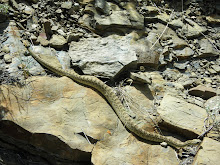
Just a quick post, with some nifty pictures of a big ol' lizard I ran across out in Utah recently. It's around 8 inches long or so (with the tail, mind you), and looks like some kind of skink-like little herp. Anybody got any better ID?
Anyway, enjoy:


Friday, June 18, 2010
Joe Barton - STILL a Stupid Bastard
A little over a year ago, the distinguished gentlemen from Texas, Joe Barton, proved himself an ass with an attempt to use the presence of oil in Alaska to prove that the Earth had been warmer IPSO FACTO Global Climate Change is a filthy commie lie. And we all had a good laugh, because he's an idiot.
Well, ol' Joe has stepped up to the plate with yet another complete asshole move: he apologized to BP for the government "shake-down" related to the colossal environmental Apocalypse proceeding down Gulf-a-ways. Because, of course, holding companies responsible for their disastrous mistakes and expecting them to behave in a responsible manner is simply un-American. Pretty awesome, Joe! Here's a short clip of the current favorite for "oily sycophant of the year award":
And hell, when even John Boehner thinks that you maybe stepped over the line a little, then man, you've really screwed the pooch!
Well, ol' Joe has stepped up to the plate with yet another complete asshole move: he apologized to BP for the government "shake-down" related to the colossal environmental Apocalypse proceeding down Gulf-a-ways. Because, of course, holding companies responsible for their disastrous mistakes and expecting them to behave in a responsible manner is simply un-American. Pretty awesome, Joe! Here's a short clip of the current favorite for "oily sycophant of the year award":
And hell, when even John Boehner thinks that you maybe stepped over the line a little, then man, you've really screwed the pooch!
Wednesday, June 16, 2010
The Little Grand Canyon of the San Rafael Swell
I recently spent around 2 weeks bopping around the west, and in particular looking at the completely rad geology to be seen in Utah, Our Nation's Prettiest State. Anyway, one of the places I camped at was a BLM campground south of Price, UT, called "The Wedge". The Wedge sits right in the heart of the San Rafael Swell. Anyway, at this spot, the San Rafael river has sliced clean through the uplift, exposing a a fair bit of the stratigraphy; the Permian Kaibab Limestone at the base, up through the Chinle/Moenkopi red beds and windblown Wingate Sandstone (Triassic), and finally the aeolian Navajo (Jurassic). It's a pretty spot, and one I'd highly recommend for camping and hiking, if you find yourself in the area. Below are some pictures, taken right from the campground, of this amazing area.

The late spring had apparently seen a fair bit of snow, so it's awfully green out that a way right now!

And here's a little evening light photomosaic to enjoy!


Tuesday, June 15, 2010
Afghanistan's Mineral "Wealth"
Apparently, Afghanistan is chock-full o' all sorts of precious metals and valuable mineral resources, at least according to the USGS (and the Pentagon Afghanistan Business development group). A recent story in the New York Times details how the USGS, with the help of some previously unstudied Afghan Geological Survey and Soviet Geological Data documents, have determined that Afghanistan has extensive deposits of lots of different kinds of minerals. These include the mundane, like copper and iron (although it appears that Afghanistan has enough of these to become a major world producer), to the more exotic, like lithium and niobium. In fact, according to the Pentagon, Afghanistan could be the "Saudi Arabia of lithium" (and, as the writers over at the Wonkette pointed out "nothing at all wrong with that sentence", right?).
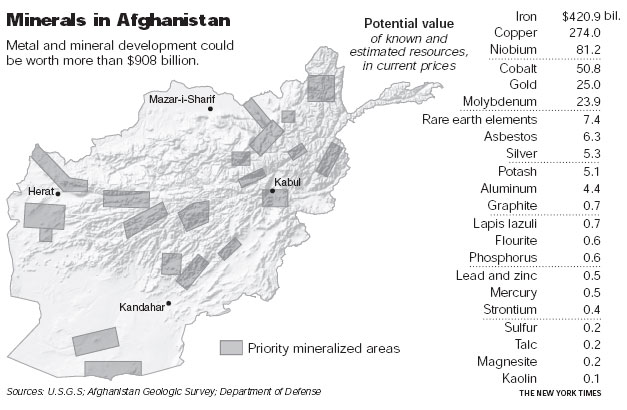
The figure below was lifted from the New York Times story, and shows the current estimates, in cash money, of the value of all the various types of raw mineral resources estimated to be present in Afghanistan. It's a lot of dollars,for sure!

The science behind the estimates is pretty interesting. In 2004, the USGS started up a project to survey Afghanistan, specifically in terms of water, hydrocarbons, and mineral resources. As part of this, they also spent a fair bit of time pouring over the old Afghan Survey maps and reports (from happier times), as well as the Soviet data. Of course, a lot of these works were 30 years old or so, and hadn't been touched during the bad old days of the Taliban. But, according to the USGS, they were interesting enough to warrant updated surveys, including magnetic and gravity studies over much of the interesting mineralization zones. The USGS has a nifty page, with a lot of summaries, downloadable maps and reports, and history of the project available here. It's neat stuff, and of course, the Geology of Afghanistan is pretty interesting reading.
Although it's great that Afghanistan has something else to possibly develop that could outstrip their current economic model (which, as of right now, is based solely on opium and raw human tragedy), there are some serious concerns, of course. First and foremost, lots of countries in History have had lots of mineral wealth, and it didn't do them to well, did it (Potosi comes to mind)? Afghanistan, ripped to shreds as it is by violence, is ripe for neoimperialist exsanguination, especially if there is a feeling that some countries are "owed" a bit of wealth do to previous investment. The rampant corruption in the Afghan government goes hand in hand with the potential for disaster; apparently, the Afghan Minister of Mines has already been dismissed do to a bribe scandal that involved Chinese copper mining interests.
And, of course, that's another problem on the horizon, too; a return to the "Great Game" of empire building in central Asia seems like a distinct possibility, especially where lots of world powers congregate around raw materials. As the New York Times story points out, China is already making overtures to Afghanistan regarding expanded mining operations.
Finally, what about the environmental and social impacts of opening up mining, willy-nilly, in a dirt poor country ravaged by four decades of war and poverty? Mining is brutal, hard work, even when done right; when it's in a far away place out of public scrutiny, troubles can start (just look at Butte, Montana, or Anaconda, Montana, for examples of home-grown exploitation and environmental/health disasters as a result of poor mining practices).
One hopes that the report of untapped mineral wealth in Afghanistan is good news; it certainly would be a nice economic booster for a country that hasn't had a good decade in a few hundred years. However, the natural pessimist in me can't help but worry about the potential for corruption and further exploitation of a country that has already experienced more than it's fair share of troubles.
The figure below was lifted from the New York Times story, and shows the current estimates, in cash money, of the value of all the various types of raw mineral resources estimated to be present in Afghanistan. It's a lot of dollars,for sure!
The science behind the estimates is pretty interesting. In 2004, the USGS started up a project to survey Afghanistan, specifically in terms of water, hydrocarbons, and mineral resources. As part of this, they also spent a fair bit of time pouring over the old Afghan Survey maps and reports (from happier times), as well as the Soviet data. Of course, a lot of these works were 30 years old or so, and hadn't been touched during the bad old days of the Taliban. But, according to the USGS, they were interesting enough to warrant updated surveys, including magnetic and gravity studies over much of the interesting mineralization zones. The USGS has a nifty page, with a lot of summaries, downloadable maps and reports, and history of the project available here. It's neat stuff, and of course, the Geology of Afghanistan is pretty interesting reading.
Although it's great that Afghanistan has something else to possibly develop that could outstrip their current economic model (which, as of right now, is based solely on opium and raw human tragedy), there are some serious concerns, of course. First and foremost, lots of countries in History have had lots of mineral wealth, and it didn't do them to well, did it (Potosi comes to mind)? Afghanistan, ripped to shreds as it is by violence, is ripe for neoimperialist exsanguination, especially if there is a feeling that some countries are "owed" a bit of wealth do to previous investment. The rampant corruption in the Afghan government goes hand in hand with the potential for disaster; apparently, the Afghan Minister of Mines has already been dismissed do to a bribe scandal that involved Chinese copper mining interests.
And, of course, that's another problem on the horizon, too; a return to the "Great Game" of empire building in central Asia seems like a distinct possibility, especially where lots of world powers congregate around raw materials. As the New York Times story points out, China is already making overtures to Afghanistan regarding expanded mining operations.
Finally, what about the environmental and social impacts of opening up mining, willy-nilly, in a dirt poor country ravaged by four decades of war and poverty? Mining is brutal, hard work, even when done right; when it's in a far away place out of public scrutiny, troubles can start (just look at Butte, Montana, or Anaconda, Montana, for examples of home-grown exploitation and environmental/health disasters as a result of poor mining practices).
One hopes that the report of untapped mineral wealth in Afghanistan is good news; it certainly would be a nice economic booster for a country that hasn't had a good decade in a few hundred years. However, the natural pessimist in me can't help but worry about the potential for corruption and further exploitation of a country that has already experienced more than it's fair share of troubles.
Sunday, May 23, 2010
Nifty Owl Video
Nothin' geo-flavored in this post: just a completely kick-ass owl video that I recently stumbled across. The video is from some Japanese TV show, but here's a brief run-down, at least as far as I can tell from the images and different critters being shown.
The owl being shown is (probably) a Common Scops Owl (Otus scops) from South Africa. First thing you'll notice, is that it is cute as hell. However, if you stick with the video a little while, they get to the point of showing that this little guy has some awesome defense/predator avoidance strategies. Here's the video:
When the little Scops owl is confronted with a barn owl (which is just a LITTLE bigger than he is), it really puffs out in an attempt to make itself look huge. But when it's confronted with the much larger and more intimidating Eagle Owl (complete with the Imperial March as it's theme song), it instead elongates itself, producing a much slimmer, narrower profile. According to this info I found at ARKive, it seems like this is a strategy meant to make the Common Scops look more like a twig or branch!
Neat!
The owl being shown is (probably) a Common Scops Owl (Otus scops) from South Africa. First thing you'll notice, is that it is cute as hell. However, if you stick with the video a little while, they get to the point of showing that this little guy has some awesome defense/predator avoidance strategies. Here's the video:
When the little Scops owl is confronted with a barn owl (which is just a LITTLE bigger than he is), it really puffs out in an attempt to make itself look huge. But when it's confronted with the much larger and more intimidating Eagle Owl (complete with the Imperial March as it's theme song), it instead elongates itself, producing a much slimmer, narrower profile. According to this info I found at ARKive, it seems like this is a strategy meant to make the Common Scops look more like a twig or branch!
Neat!
Monday, May 17, 2010
Geomorphology From Space!!!
I recently came across a pretty neat Earth Science resource hidden away on the interwebs here, and I thought I'd share. The Goddard Earth Science Data and Information Service Center's website is, of course, a neat source for a lot of NASA flavored Earth Science info; however, they ALSO have put online a pretty big digital collection of ~270 plates from the out-of-print 1986 book "Geomorphology From Space".
It's got some neat images and interpretive maps for a variety of fairly stunning landforms, although keep in mind this was 1980s-quality pictures...of course, you could probably easily upgrade to better images via Landsat or something.
Anyway, it's pretty neat!
It's got some neat images and interpretive maps for a variety of fairly stunning landforms, although keep in mind this was 1980s-quality pictures...of course, you could probably easily upgrade to better images via Landsat or something.
Anyway, it's pretty neat!
Sunday, May 16, 2010
Mangrove Evolution and Plate Tectonics
More Mangrove madness for May, I guess! Anyway, my previous post about some of the nifty mangroves I'd seen down in the Everglades got me thinkin': what's the evolutionary history of mangroves? Turns out, that's kind of a tricky topic, and one that ends up incorporating a lot of interesting taxonomic, ecological, botanical, and paleobotanical perspectives; as a for-instance, it requires that you make some clear definitions regarding what you mean by "mangrove". In one sense, you can talk about the taxonomic group of fruiting plants that we call "Mangroves" (which includes a lot of ~22 families). HOWEVER, in another sense, we can talk about the ECOLOGICAL niche of "mangroves", i.e., coastal swamps that develop as a result of biologically-mediated factors. A future post will explore those topics in more detail.
THIS post, however, is going to focus on some slick work (in my opinion) that has been done linking mangroves (including genetics AND fossils) with the geological factors that influenced their evolutionary history.
Workers with interests in mangroves have long recognized an interesting pattern in modern mangrove (taxonomically-defined) biogeography, namely that Mangrove species richness declines dramatically from a peak in the West Pacific to a minimum in the Caribbean/West Atlantic Zone. The figure below is from Ellison et al. (1999) that shows this pattern diagrammatically.

There are two explanations that have been put forth to explain this pattern. Originally, mangrove biogeography was explained in the context of an Indonesia/West Pacific "Center of Origin" distribution (Duke, 1995). In otherwords, mangrove taxa originated in one spot, and then subsequently disperesed globally. This is easily the oldest explanation for this observed pattern of diversity, and goes back into the literature for ~100 years.
After the plate tectonic revolution, however, another explanation presented itself: namely, that mangrove taxa evolved around the Tethys seaway in the late Cretaceous, and regional diversity is the result of diversification and evolution in the context of plate tectonics and the movement of continents (Ellison et al., 1999). This has been termed the "vicariance hypothesis", and is the big focus of the paper by Ellison et al. (1999).
Ellison et al. (1999) explore several lines of evidence as a means of testing the validity of one or the other hypotheses, and frankly, I think they're rather clever: FIRST, they take a look at the paleobiogeography of fossil mangroves (pollen or macrofossils) and compare that to modern biogeographic patterns. Ellison et al. (1999) compile a substantial list of fossil mangrove occurrence, and demonstrate that, actually, the fossil record is pretty damn good! The figure below is from Ellison et al. (1999; their figure 2), and shows generalized maps of mangrove occurrence through time.

Importantly, on the basis of their fossil mangrove occurrence database, Ellison et al. (1999) report that, statistically, there isn't any significant correlation between mangrove species-area occurrences and distance from the Indonesian/West Pacific region throughout the Tertiary. What is demonstrated, however, is that mangrove fossil occurrence shows a relativly wide-spread distribution of different mangrove taxa along the ancient Tethyan shoreline. Ellison et al. (1999) recognize that this conclusion provides testable hypotheses for relating other strongly correlated ecological aspects of mangrove environments.
This conclusion leads to their SECOND approach to interrogating mangroves....SNAILS. Turns out, mangroves have some pretty conservative associations with different gastropod taxa; in otherwords, the specific ecology and environmental stresses associated with Mangroves has also resulted in snail populations that almost always co-occur. Cooly, Ellison et al (1999) compile a fossil-occurrence database of gastropods, and compare that distribution to their fossil mangrove database! Neat, huh? Their results are shown below, in their Figure 3:

They proceed to explore ecological "nestedness" of gastropods and mangroves through time, and do some pretty nifty statistical manipulations of the data to test whether mangroves, their gastropods, and the species-area relationships can be associated with a "center-of-origin". Ellison et al. (1999) conclude that, on the basis of the fossil distributions of both mangroves, gastropods, and the patterns of their species-area relationships, that a probable Tethyan origin, and then subsequent diversification patterns are related to tectonic reconfiguration of shorelines and continents. Neat, huh!
It's a pretty neat use of both modern biogeographic patterns as well as ancient data, and it makes me wonder what other possible insights could be mined from both this and other settings? For instance, is there anything we could learn about large-scale paleo-oceanographic circulation patterns from these paleobotanical collections? Can we see other ecosystems being strongly influenced by tectonics in this way? Can we take the fossil record of mangroves, tie it to associated mangrove-dominated depositional environments, and see any statistical patterns in stratigraphic occurrence, mangrove biogeography, and tethyan tectonics? Or how expanding out from the "taxonomic" mangroves into the "ecologic" mangroves, which have a (potentially) older fossil record? Are there any statistical patterns to be elucidated from those occurrences? Who knows!?
Regardless, mangroves are obviously pretty amazing plants, but also seem to have a geological story to tell us as well! Maybe it's time us rock-o-centric types start really thinking about some of the critter-o-centric fields, and how one can inform the other in new and exciting ways.
WORKS CITED:
Duke, N.C., 1995, Genetic diversity, distributional barriers and rafting continents - more thoughts on the evolution of mangroves: Hydrobiologia, v. 295, p. 167-181.
Ellison, A.M., Farnsworth, E.J., and Merkt, R.E., 1999, Origins of mangrove ecosystems and the mangrove biodiversity anomaly: Global Ecology and Biogeography, v. 8, p. 95-115.
Monday, May 3, 2010
Modern Mangroves
Just a brief picture-y related post, as I try and rise above the clinging busy-ness of the end-o'-the-semester. I was lucky enough to head down to South Florida over the spring break (in late March), and in addition to eating all sorts of delicious shell fish and exotic fruits (sapote! sapodilla!) I also had the chance to see some pretty rad mangroves swamps!
Mangroves, of course, are the utterly kick-ass salinity-tolerating plants that form impressively dense coastal swamps along tropical shorelines. Because they live in environments that are, traditionally, so hostile to plants, these awesome trees have evolved some pretty slick adaptations. They can excrete excess salt from their roots and leaves, which is pretty awesome, and can similarly limit water loss during low-tide exposures. And, from a sedimentological view point, they are also completely amazing sediment baffles, effective at dissipating incoming wave energy and trapping any entrained sediment. Neat-o!
Anyway, the picture below is from Florida bay, and just shows some isolated red mangroves growing out in the shallows. When we came back and mucked around in the mud after low tide, the WHOLE area was just covered in horseshoe crab traces going everywhere (no pictures, sadly...). In the background on the right, you can JUST make out the distopian hellscape that is Miami.

This next picture is from the Everglades, and shows some more Red Mangroves growing along the edge of the brackish water Coot Bay, and were taken as we canoed around the backwaters. Notice the oysters encrusting the mangrove limbs! Neat!

Here's another oyster and mangrove shot!

And, finally, here's some mangrove pneumatophores exposed along the canal access to Coots Bay.

Pretty amazing plants!
Subscribe to:
Posts (Atom)