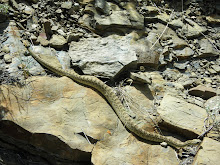
Pretty busy here...lots o' writtin', lots o' workin', and even a little bit o' thinkin' going on. Anyway, I really just wanted to grab a Leap Day post, so here's a picture of some rad soft-sed deformation from the Wilkins Peak arkosic intervals in SW Wyoming. Enjoy!
Back to work!
Wednesday, February 29, 2012
Wednesday, February 1, 2012
50 Most Loathsome Americans List!
It's here! The crafty bastards at the Buffalo Beast have finally released their annual list of the 50 most loathsome Americans! Go and READ IT now! Who knows; maybe you made it this year!?!
Sunday, January 15, 2012
Sed Structure Sunday - Adhesion Ripples!
As previously mentioned, my visit to Sandy Hook in New Jersey was on a pretty damn windy day. Big, 40 mph gusts were walloping the beach, coming in obliquely off the sea an onto the sandy foreshore. These winds were mobilizing a LOT of material, saltating medium-grained sands along the damp shoreline, producing a perfect opportunity to catch some pretty neat eolian sedimentary structures. Behold! Adhesion Ripples (Camera case for scale)!
Adhesion ripples are formed when dry, wind blown sand gets glommed onto a wet, sticky surface; the fancy word for such glommification is "adhesion", et viola: Adhesion Ripples! They differ from the traditional ripple cross-laminated sands in a variety of important ways, the most fundamental difference being that there isn't any evidence for the traditional grain-flow structure in the laminations, which would be expected if these structured formed as part of a migrating bedform. More qualitatively, these structures just seem weird, with chunks and bits stuck onto a wavy surface in a way that just LOOKS different from the directional migration of sedimentary structures.
Kocurek and Fielder (1982) elucidated their genesis through a variety of flume/wind tunnel experiments, and also noted their occurrence in ancient eolian deposits. In fact, the same quarries that produce the jellyfish impressions in the Cambrian of Wisconsin ALSO produce some pretty nice examples of adhesion ripples. These are actually pretty handy structures, and have been used as evidence for a subaerial phase in some of these enigmatic mid-continent sandstones everyone seems to fond of.
Anyway, a little known but potentially quite helpful sedimentary structure to keep in mind when out looking at the rocks!
Adhesion ripples are formed when dry, wind blown sand gets glommed onto a wet, sticky surface; the fancy word for such glommification is "adhesion", et viola: Adhesion Ripples! They differ from the traditional ripple cross-laminated sands in a variety of important ways, the most fundamental difference being that there isn't any evidence for the traditional grain-flow structure in the laminations, which would be expected if these structured formed as part of a migrating bedform. More qualitatively, these structures just seem weird, with chunks and bits stuck onto a wavy surface in a way that just LOOKS different from the directional migration of sedimentary structures.
Kocurek and Fielder (1982) elucidated their genesis through a variety of flume/wind tunnel experiments, and also noted their occurrence in ancient eolian deposits. In fact, the same quarries that produce the jellyfish impressions in the Cambrian of Wisconsin ALSO produce some pretty nice examples of adhesion ripples. These are actually pretty handy structures, and have been used as evidence for a subaerial phase in some of these enigmatic mid-continent sandstones everyone seems to fond of.
Anyway, a little known but potentially quite helpful sedimentary structure to keep in mind when out looking at the rocks!
Friday, January 13, 2012
Crab Pavement!
Day three of our "dead beach stuff" marathon here at the ol' Blog; you can catch up on all the grim action on these previous posts. Anyway, today's litore mortem comes again from the Jersey coastline at Sandy Hook. It was a blustery day, with 40 mph gusts along the shoreline, and very very very cold. Anyway, the wind was SO strong, it was pretty actively entraining some sand, leaving behind only the largest clasts, including...a whole bunch of dead crabs!
These crabs were littered everywhere, and the aeolian evacuation of sand was leaving behind the crustaceans to form a nifty little crab-enriched interval.
Gruesome, ain't it!?!
Sometimes, the crabs were serving as baffles to the blowing sand, like this little guy below:
Nifty!
These crabs were littered everywhere, and the aeolian evacuation of sand was leaving behind the crustaceans to form a nifty little crab-enriched interval.
Gruesome, ain't it!?!
Sometimes, the crabs were serving as baffles to the blowing sand, like this little guy below:
Nifty!
Thursday, January 12, 2012
More Dead Things on the Beach!
Continuing the trend from yesterday, here's another picture of some dead stuff I found on the beach over the holiday break! We've moved out of the Gulf and onto the Atlantic coast, and a far bit more northward as well; these pictures are from Sandy Hook, off the coastline of New Jersey. It's a ray, washed WAAAAAAAY the hell up on the backshore during a pretty tremendous storm that hit the Atlantic coast.

And here's the poor critter, flipped over.

And here's the poor critter, flipped over.
Wednesday, January 11, 2012
Jellyfish on the Beach
The shoreline is always a fun place to visit; not only is it a picturesque confluence of all sorts of sedimentary and geomorphic processes mingling and interacting with on another, but there's all sorts of wiggy critters and nifty biology to see as well. Over the break, I had the chance to spend a lovely day at the beach on St. George's island, a barrier island in the Gulf of Mexico not too far from the Oyster Capital of the Gulf, Apalachicola Florida. Some recent storms had stirred up the shoreface a bit, resulting in some pretty nifty shell hashes and fragments scattered all over. However, along with the biomineralized detritus cast up by storm waves, there were also a fair number of these guys:
Jellys! Subaerially exposed! Some of these, like the one in the picture above, were exposed in the littoral zone, but a few of comparable size had been chucked up pretty far onto the beach, out of range of fairweather wave activity. Always fun to see cnidarians, especially when the chance of getting stung in minimal. Anyway, seeing all these jellys, deposited on well-sorted, upper fine- to medium- grained sand got me thinking about a taphonomy...after all, Jellys aren't called Jellys out of some wry sense of irony. These soft, squishy, blobby little guys, chucked up into high-energy settings like the foreshore, don't have much of a chance at preservation, especially with a bunch of other critters rambling about over the beach. However, such was not always the case!
A similar occurrence of cnidarians and high-energy deposits has been documented from the Cambrian, with some very nice examples coming out of the midcontinent region in particular. Hagadorn et al. (2002) documented a pretty awesome occurrence from the "middle" Cambrian Mt. Simon/Wonewoc sandstones. Below is their Figure 3, from page 149.
Pretty cool! It's a little more densely packed with the tragically stranded cnidarians, and the sedimentary structures are different, but all in all, it's pretty much a Cambrian example of my day at the beach!
Hagadorn et al. (2002) noted that, as discussed above, the taphonomy of jelly preservation requires some sort of explanation. First off, these deposits don't show any evidence for rapid burial, one of the more commonly evoked explanations for exceptional fossil preservation. Rather, these jellyfish show themselves, on the basis of both sedimentary structures and the overall stratigraphic succession, to have been deposited in a fairly active shoreface/foreshore paleoenvironment. Additionally, there's no evidence in these rocks for microbial structures or features, meaning that we can't evoke a "gooey substrate" explanation, either. So, how did these guys get into the rock record!?
An important hint, recognized by Hagadorn et al. (2002), can be found in the explanation of why washed up jelly's DON'T get preserved today...namely, lots of scavenging terrestrial critters and especially lots of deep digging bioturbators. One of the ways the weird world of the Cambrian differs from ours today is the fact that the organisms that do those things hadn't evolved yet, meaning that, for a brief window of time, these sort of "stranding" deposits of organisms are actually pretty darn likely to enter the stratigraphic record.
Just goes to show you that, in addition to our uniformitarian world view, we also have to keep in mind the arrow of secular variation, and how dynamic and complex the interaction is between critters and their environments.
WORKS CITED
Hagadorn, J.W., Dott, R.H., Jr., and Damrow, D., 2002, Stranded on a Late Cambrian shoreline: Medusae from central Wisconsin: Geology, v. 30, p. 147-150
Jellys! Subaerially exposed! Some of these, like the one in the picture above, were exposed in the littoral zone, but a few of comparable size had been chucked up pretty far onto the beach, out of range of fairweather wave activity. Always fun to see cnidarians, especially when the chance of getting stung in minimal. Anyway, seeing all these jellys, deposited on well-sorted, upper fine- to medium- grained sand got me thinking about a taphonomy...after all, Jellys aren't called Jellys out of some wry sense of irony. These soft, squishy, blobby little guys, chucked up into high-energy settings like the foreshore, don't have much of a chance at preservation, especially with a bunch of other critters rambling about over the beach. However, such was not always the case!
A similar occurrence of cnidarians and high-energy deposits has been documented from the Cambrian, with some very nice examples coming out of the midcontinent region in particular. Hagadorn et al. (2002) documented a pretty awesome occurrence from the "middle" Cambrian Mt. Simon/Wonewoc sandstones. Below is their Figure 3, from page 149.
Pretty cool! It's a little more densely packed with the tragically stranded cnidarians, and the sedimentary structures are different, but all in all, it's pretty much a Cambrian example of my day at the beach!
Hagadorn et al. (2002) noted that, as discussed above, the taphonomy of jelly preservation requires some sort of explanation. First off, these deposits don't show any evidence for rapid burial, one of the more commonly evoked explanations for exceptional fossil preservation. Rather, these jellyfish show themselves, on the basis of both sedimentary structures and the overall stratigraphic succession, to have been deposited in a fairly active shoreface/foreshore paleoenvironment. Additionally, there's no evidence in these rocks for microbial structures or features, meaning that we can't evoke a "gooey substrate" explanation, either. So, how did these guys get into the rock record!?
An important hint, recognized by Hagadorn et al. (2002), can be found in the explanation of why washed up jelly's DON'T get preserved today...namely, lots of scavenging terrestrial critters and especially lots of deep digging bioturbators. One of the ways the weird world of the Cambrian differs from ours today is the fact that the organisms that do those things hadn't evolved yet, meaning that, for a brief window of time, these sort of "stranding" deposits of organisms are actually pretty darn likely to enter the stratigraphic record.
Just goes to show you that, in addition to our uniformitarian world view, we also have to keep in mind the arrow of secular variation, and how dynamic and complex the interaction is between critters and their environments.
WORKS CITED
Hagadorn, J.W., Dott, R.H., Jr., and Damrow, D., 2002, Stranded on a Late Cambrian shoreline: Medusae from central Wisconsin: Geology, v. 30, p. 147-150
Labels:
beaches,
critters,
paleo,
paleoenvironments,
taphonomy
Steno on Google!
Jumpin' Cats! Take a look at today's Google Doodle thingy...it's Nick Steno's 374th B-Day, and they've got a cartoon in honor of it! Neat-o!
Steno has, of course, been mythologized as one of the fabled "father's o' geology", most often remembered for his "three Laws": Original Horizontality, Lateral Continuity, and of course Superposition. Pretty nice exposure!
EDIT: I guess it is a bit layer-cakey...maybe for Wheeler's Birthday, they'll have an animated one that blows it apart and constructs a Wheeler Diagram, to show the difference between time-as-rock and time-as-surfaces.
Steno has, of course, been mythologized as one of the fabled "father's o' geology", most often remembered for his "three Laws": Original Horizontality, Lateral Continuity, and of course Superposition. Pretty nice exposure!
EDIT: I guess it is a bit layer-cakey...maybe for Wheeler's Birthday, they'll have an animated one that blows it apart and constructs a Wheeler Diagram, to show the difference between time-as-rock and time-as-surfaces.
Tuesday, January 10, 2012
Desert Horned Lizard!
A quick picture of some more neat-o herpetofauna! This one is a desert horned lizard, from the Valley of Fire State Park in Nevada.
Pretty slick camo, eh?
Monday, December 12, 2011
Privilege, Equality, and Disparity: A Link To A Totally Rad Essay
I just wanted to quickly point out a really excellent essay that does a killer job deconstructing and exploring the (sometimes stealthy) role that "privilege" has in creating disparities between folks. The essay, titled "Sacrificing Privilege" and hosted at Skepchick, is a clear and well-written exploration of how a "privileged" status, defined on the basis of race, gender, or what-have-you, can serve as the basis of a pervasive and potentially "invisible" culture of bias.
This is an extremely important message that we in the sciences (and especially the Earth Sciences) NEED to understand if we ever want to get away from the "(White) Boys' Club" that defines so many fields. As discussed here in a previous post, Geology has a real problem with regards to gender; understanding and working to eliminate the (often hidden) cultural biases that make it hard for women and minorities to find a home in the sciences is the only way that we'll ever get better. So everyone read the essay linked above! It's long, but well worth the time!
Tuesday, December 6, 2011
Evaporite Casts in Sandstone
I've been working, as part of the ol' PhD rigamarole, in the Wilkins Peak Member, which is part of the Eocene Green River Formation in southwest Wyoming. Anyway, this part of the world during the Eocene was characterized by extremely high evaporation coupled with relatively low precipitation, which is a perfect setting for the formation of evaporites! High evaporation rates drive off water, while leaving behind water soluable ions, resulting over time in highly concentrated brines from which evaporite minerals form.
In previous posts, I've shown some modern examples of evaporite formation from Death Valley, where evaporites are precipitating on a playa surface, which is a pretty good analogue for parts of the Wilkins Peak. This previous post actually shows some evaporite mineral casts from the purely lacustrine portion of the Wilkins Peak, probably some sort of Na-rich evaporite.
However, you don't have to be in the lake for evaporites to form! These pictures below are evaporite mineral casts preserved in sandstones that formed as part of the floodplain/overbank setting of a fluvial system that fed into the lake.
Here's a closer view, showing the bladed, fairly delicate looking crystalline features of the evaporites, preserved in the sands.
I reckon these are Nahcolite casts, on account of their elongated crystal habit, but then again I'm no evaporite specialist. Still, they're kind of nifty!
In previous posts, I've shown some modern examples of evaporite formation from Death Valley, where evaporites are precipitating on a playa surface, which is a pretty good analogue for parts of the Wilkins Peak. This previous post actually shows some evaporite mineral casts from the purely lacustrine portion of the Wilkins Peak, probably some sort of Na-rich evaporite.
However, you don't have to be in the lake for evaporites to form! These pictures below are evaporite mineral casts preserved in sandstones that formed as part of the floodplain/overbank setting of a fluvial system that fed into the lake.
Here's a closer view, showing the bladed, fairly delicate looking crystalline features of the evaporites, preserved in the sands.
I reckon these are Nahcolite casts, on account of their elongated crystal habit, but then again I'm no evaporite specialist. Still, they're kind of nifty!
Subscribe to:
Posts (Atom)